
Welcome! Are you ready to experience some marketing magic? This week’s class was all about taking a closer look at how companies break down their audiences to create powerful, targeted campaigns. It was a lecture filled with magical insights, from understanding consumer behaviour to identifying a “perfect” target market using the STP process. Similarly to alchemists turning metal into gold, let’s uncover how the art of segmentation can be used to create gold-standard marketing strategies.
Let’s begin by asking: what do we mean by market segmentation?
For a company, there are a lot of potential customers on the planet. And obviously, you can’t target everyone (well, you can try, but it won’t be effective). In order to effectively target your advertising campaign to the right people, at the right time, individuals need to be split into groups of similar characteristics and qualities. This division of people is what we call market segmentation.
Market segmentation is crucial for advertisers because it allows a company to understand the needs and wants of their potential customers and create personalized content for a specific audience.
Let’s take a look at the 4 main markets of segmentation: demographic segmentation, behavioural segmentation, geographic segmentation, and psychographic segmentation. Let’s have a closer look at each of these.
Demographic segmentation is the most common segmentation form, and refers to using observable differences, such as age, sex, income, race, nationality, religion, etc, to narrow down your target market.
Geographic segmentation refers to splitting up the market based on location. It aims to provide an understanding of the specific needs of certain regions. This includes identifying users based on their country, state, city, or zip-code, as well as population density, such as urban, suburban, or rural.
However, it’s important to remember from Terry O’Reilly’s podcast episode titled “Where you live dictates what you buy”, even regions a few kilometres away from one another can have completely different preferences. Therefore, it’s important to keep in mind that there is no “one size fits all” marketing strategy when referring to larger regions. This segmentation approach helps ensure strategies are tuned to the unique needs and preferences of each localized market, maximizing the effectiveness of the campaign.
Behavioural segmentation is the division of the market based on consumers’ behaviours, especially in consideration to how someone interacts with your product and brand. This involves (but is not limited to):
- How often they use a product
- When they use a product
- Whether they are loyal users of a product
- Whether they are first time users of a product
And last but not least, psychographic segmentation includes personality traits, interests, beliefs, values, attitudes, and lifestyle, and give insight into why people decide to purchase (or not purchase) your product.
Now, let’s put this theory into practice using one of my favourite brands… Patagonia! (disclaimer: expect to hear A LOT about Patagonia throughout this blog, I think they are marketing geniuses)
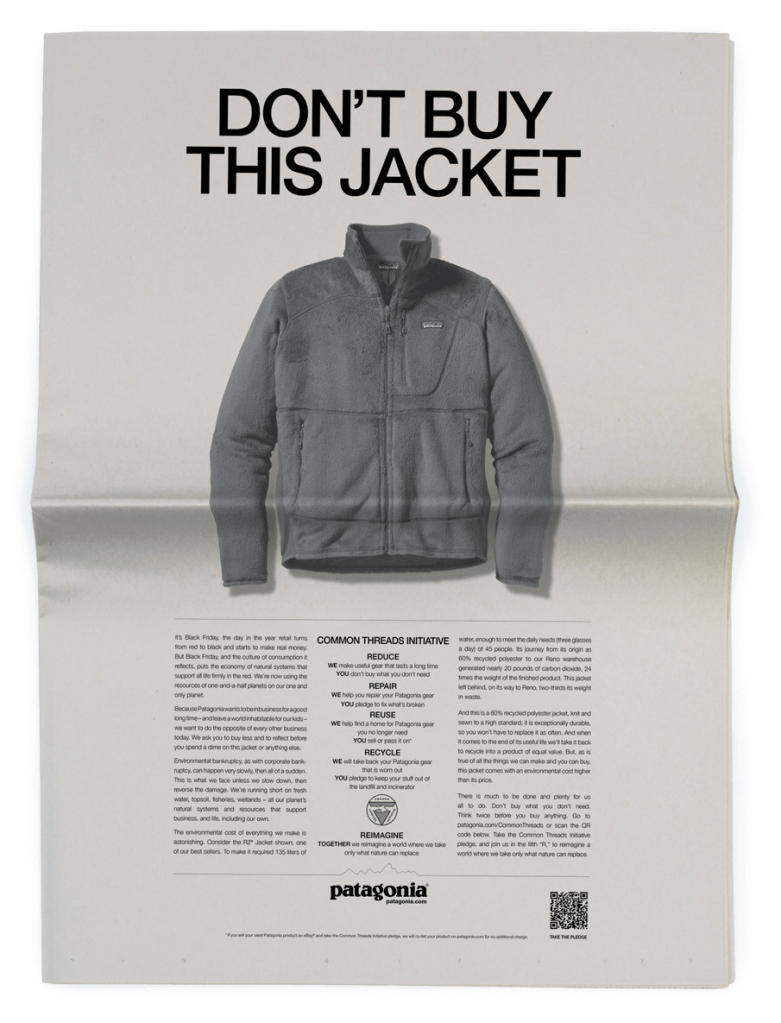
One of my favourite advertising campaigns was run on Black Friday 2011 by Patagonia, titled “Don’t Buy This Jacket” [pictured, right]. This ad aimed to raise consumer awareness regarding the consequences of over-consumption, especially on Black Friday. Patagonia believed that in order to reduce environmental footprint, everyone ultimately needs to consumer less (Patagonia, 2011). And they are right! Despite being a sustainable clothing brand (every item is made with organic and/or recycled materials), the production of each garment still emits greenhouse gases, requires ample amounts of freshwater, and generates half a garments worth of scrap (Patagonia, 2011). Patagonia’s mission is well-known: “We’re in business to save our home planet” Therefore, it would be hypocritical if the company contributed to the mass levels of advertising encouraging over-consumption during Black Friday Weekend.
A New Perspective
Let’s put ourselves in the shoes of Patagonia’s marketing team. Who is this ad really trying to target? What kind of people are they? To provide an example, I’ve analyzed Patagonia’s target market using the segmentation tactics we’ve discussed to gain deeper insights into how precise market segmentation can enhance the effectiveness and resonance of advertising campaigns.
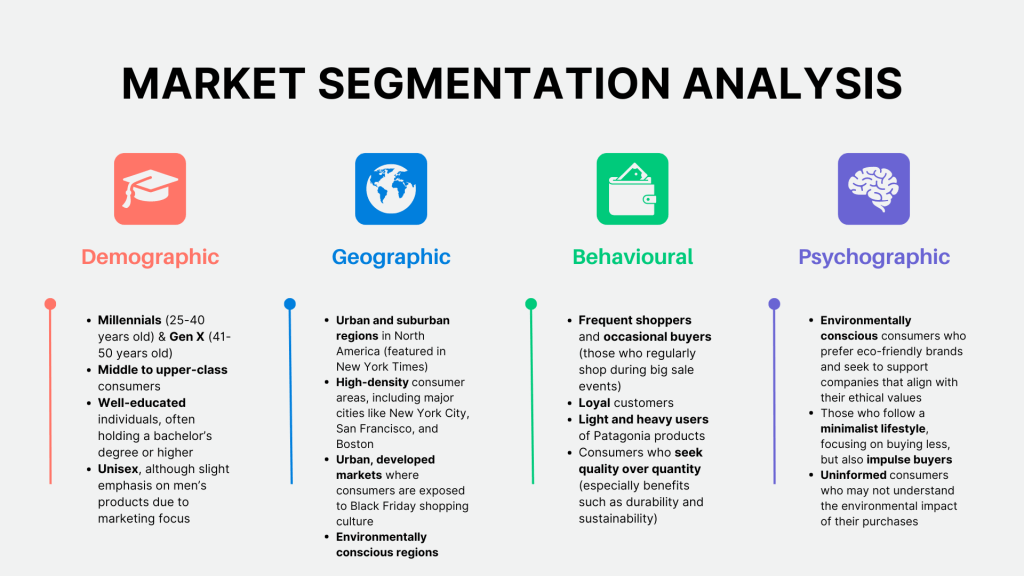
Patagonia’s campaign is innovative in strategic messaging; by focusing on reducing unnecessary consumption, Patagonia targets eco-conscious individuals who are already passionate about sustainability. But what’s more impressive is how the campaign extends beyond its core audience, simultaneously encouraging a wider audience to minimize over-consumption trends, even if environmental concerns are not in the consumer’s evoked set. Brilliant, right?!
As someone who values sustainability, especially when it relates to the retail and clothing industry, Patagonia’s message really connects with me and my values. It is extremely inspiring to see a brand prioritize planet over profit. The message of “Don’t Buy This Jacket.” resonates with me because I, like many others, tend to engage in over-consumption – it’s an unfortunate habit that often feels unavoidable in a consumer-driven society. This advertisement encourages self-reflection regarding my own spending habits. Now, when purchasing new items from retail stores, I ask myself “Do I really need this product?”, “Am I being influenced by sales and marketing tactics?”, and “What is the true cost of this product?”.
Through exploring Patagonia’s “Don’t Buy This Jacket” campaign from a segmentation perspective, it is evident how advertising is used to influence consumer behaviour. While Patagonia’s message promotes sustainability in the retail industry, it also demonstrates how marketing can subtly manipulate our choices by appealing to our values and guilt. By targeting both eco-conscious individuals and over-consumers, this campaign showcases how marketing tactics can shape our buying decisions. This example highlights the use of a positive message, but not all advertisements have pure intentions. Recognizing these influences can empower us to make more informed and intentional choices. How often do we consider the underlying motivations behind the marketing messages we encounter on a day-to-day basis? Pay attention to the ads that surround you and ask yourself “am I aware of how these strategies are shaping my purchasing decisions, and my values?”
Works Cited:
Patagonia. “Don’t Buy This Jacket, Black Friday and the New York Times.” Patagonia, 25 November 2011, https://www.patagonia.ca/stories/dont-buy-this-jacket-black-friday-and-the-new-york-times/story-18615.html. Accessed 16 September 2024.
· · ─ ·☽𖤓☾· ─ · ·
Thank you for reading and I’ll see you next week for another dose of advertising alchemy! -Adie
 Adie’s Advertising Alchemy
Leave a comment